Gujarat is one of India’s most prominent industrial states, with a diverse manufacturing ecosystem covering engineering, construction, automotive, renewable energy, electrical equipment, machinery, and infrastructure. As these industries increasingly seek lightweight, durable, and versatile materials, aluminium sections have become an important component in modern manufacturing. A reliable Aluminium Section Manufacturer / plant in gujarat can provide standard and customized aluminium sections designed to meet the technical requirements of a wide range of applications.
Aluminium sections are primarily produced through an extrusion process. During extrusion, a heated aluminium billet is forced through a specially designed die to create a profile with a particular cross-sectional shape. This process offers manufacturers considerable design flexibility while allowing customers to obtain profiles with consistent dimensions and excellent material efficiency.
Gujarat’s Strong Position in Aluminium Manufacturing
Gujarat provides an excellent environment for aluminium section manufacturing because of its established industrial infrastructure, skilled workforce, transportation network, and large base of engineering and manufacturing companies. Industrial regions across the state generate demand for aluminium profiles used in machinery, construction, solar systems, furniture, electrical products, and automotive components.
The state’s connectivity through highways, railways, and ports also supports the efficient movement of raw materials and finished products. This enables an Aluminium Section Manufacturer / plant in gujarat to serve customers within the state as well as businesses located in other parts of India and international markets.
Aluminium Section Manufacturing Process
A modern aluminium section plant follows a series of carefully controlled manufacturing stages. The process generally begins with selecting the appropriate aluminium alloy based on the required strength, application, surface finish, and environmental conditions.
Aluminium billets are heated to a controlled temperature and then pushed through an extrusion die. The die determines the final shape of the aluminium section. After extrusion, the profiles are cooled and may undergo stretching or straightening to achieve the required dimensional accuracy.
The sections are then cut to specified lengths. Depending on customer requirements, manufacturers can provide additional services such as ageing, anodizing, powder coating, polishing, machining, drilling, punching, and fabrication.
Quality inspection is performed throughout the manufacturing process to ensure that profiles meet the required dimensional, surface, and performance specifications.
Applications of Aluminium Sections in Gujarat
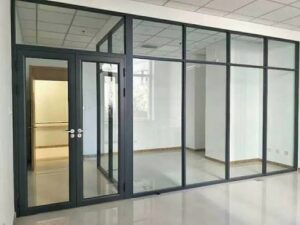
Aluminium sections are used across numerous industries. In construction and architecture, they are commonly used for doors, windows, partitions, facades, curtain walls, railings, roofing systems, and structural applications.
Gujarat’s engineering and machinery sectors can use aluminium sections for machine frames, equipment structures, workstations, conveyor systems, safety guards, and industrial enclosures. Their lightweight properties make them particularly useful for modular structures that may require assembly, modification, or relocation.
The electrical and electronics industries also use aluminium profiles for cabinets, housings, heat sinks, mounting structures, and equipment frames. Aluminium’s ability to conduct and dissipate heat can be valuable for thermal management applications.
Another growing area is renewable energy. Solar mounting structures frequently use aluminium sections because they need materials that are lightweight, durable, and resistant to outdoor conditions. As renewable energy installations continue to expand, demand for suitable aluminium profiles can increase accordingly.
Key Benefits of Aluminium Sections
One of the main advantages of aluminium sections is their excellent strength-to-weight ratio. Aluminium is lightweight compared with many other metals while providing useful structural performance. This can reduce handling, transportation, and installation requirements.
Aluminium also has good natural corrosion resistance. The protective oxide layer that forms on its surface helps protect the material from environmental exposure. Anodizing and powder coating can provide additional protection while offering different aesthetic finishes.
Design flexibility is another major advantage. Extrusion technology enables manufacturers to produce profiles with complex shapes and customized dimensions. Businesses can therefore develop sections specifically suited to their products or projects.
Aluminium’s recyclability is also important for modern industries. Recycled aluminium can be used in new applications, helping businesses improve material efficiency and support more sustainable manufacturing practices.
Choosing the Right Aluminium Section Manufacturer
When selecting an Aluminium Section Manufacturer / plant in gujarat, businesses should assess several factors. These include extrusion capacity, alloy options, tooling expertise, profile size capabilities, surface treatment facilities, quality-control systems, production consistency, and delivery performance.
A dependable manufacturer should be capable of understanding technical drawings and producing sections according to precise specifications. Consistent dimensions, straightness, surface quality, and finish are particularly important for applications requiring accurate assembly.
Manufacturers offering integrated services such as extrusion, cutting, anodizing, powder coating, machining, and fabrication can provide additional convenience. They can reduce the need to coordinate with multiple suppliers and help streamline the procurement process.
Future Growth of Aluminium Section Manufacturing
Gujarat’s expanding construction, engineering, automotive, renewable energy, and industrial automation sectors are expected to create continued opportunities for aluminium section manufacturers. The increasing demand for lightweight designs and energy-efficient solutions is encouraging businesses to explore aluminium for applications traditionally served by heavier materials.
Advancements in automation, extrusion machinery, die design, surface treatment, and quality inspection are also improving manufacturing capabilities. These technologies can help Gujarat-based manufacturers increase productivity and maintain consistent quality while serving both domestic and export markets.
Conclusion
An Aluminium Section Manufacturer / plant in gujarat plays an important role in supporting the state’s diverse industrial ecosystem. Aluminium sections provide a combination of lightweight construction, durability, corrosion resistance, design flexibility, and recyclability, making them suitable for numerous applications.
With advanced extrusion technology, skilled professionals, customization capabilities, and strong quality-control practices, Gujarat’s aluminium section industry can continue to support the evolving needs of construction, engineering, solar, automotive, electrical, and industrial businesses. As the state’s manufacturing sector continues to grow, the demand for high-quality aluminium sections is likely to remain strong.